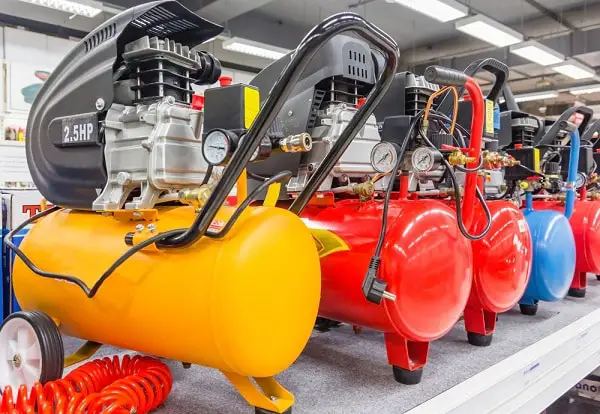
That’s when you look at the spec sheet of the latest Ingersoll Rand air compressor. A big bold number catches your eye. Seven horsepower it says.
Sounds like plenty to run your framing nailer, your impact wrench and perhaps even your paint sprayer. You purchase it, lug it home, connect it, and…you’re underwhelmed. Performance are sluggish.
It take a long time to recover. Hmmm, did I get taken by a air compressor that was marketed as powerful and delivers only sufficient air pressure to illuminate the room? It is not unusual; this confusion results from decades of marketing tricks.
The number on the box rarely tells whole truth, and sometimes it tell you nothing useful at all. If I see horsepower on a small shop compressor, I have to pause. That is a very high peak rating.
Understanding Air Compressor Horsepower Ratings
The Horsepower Marketing Myth
It is a theoretical maximum under ideal conditions that will never exist in your garage. Horsepower are a key to buying the right tool because it lets you understand the difference between what motor can do for an hour vs what the motor can do for a second. This keeps you from spending money on empty promises.
Peak Versus Real Horsepower
There are basically two types of horsepower used in the industry, and the terms aren’t interchangeable. One is called peak horsepower which is the motors ability to start; i.e., the burst of energy needed to overcome inertia and get flywheel spinning from a dead stop. So it’s torque to crank the flywheel over.
Because that take more torque than operating the motor does, it’s a higher number. But what the peak rating doesn’t account for is that there’s less load on the motor once compressor spins up. And that’s where you find out what it really puts out as opposed to just what it throws at you initially.
This is why many folks don’t see that when comparing one model different than another. The problem with the rating is that it measure the maximum continuous power output of the motor, which realy means how much continuous air it can pump out. It factors in electrical resistance, the heat generated and the friction created as the motor runs.
While a manufacturer may rate its motor as seven peak horsepower, the same motor could only put out three or four real horsepower. The difference can be considerable. Why?
Manufacturers quit putting the real horsepower on most motors sold to consumers. They like using a bigger number because it makes the motor look stronger on the shelf, regardless of what it actualy does for you. You get the illusion of strength but pay full price for it.
Confusing Industry Ratings
To make things even more confusing, there isn’t a standardized way of measuring small compressors in the DIY market. Large commercial ones has stricter regulations while smaller ones do not. Because of this, you’ll hear talk about things like BSA horsepower or service factor, which adds to the confusion.
Service factor is a multiplier that tells you how much you can overload the motor without burning it out. It’s good info to know, but it isn’t horsepower. It’s a safety margin.
Why CFM Matters More
Merging those two ideas add a distraction to the conversation that takes away from the metric that realy matters for powering your tools: air delivery rate. Cubic Feet per Minute (CFM) is not as sexy as horsepower, but consider this: CFM indicates how many cubic feet of air are being delivered by your compressor at any given psi. Your nail gun require a certain number of CFM at 90psi to properly shoot.
Peak horsepower won’t make up for air that doesn’t exist. Sometimes a small motor with a well designed pump can out perform a large motor that’s poorly designed. The heart of the system is the pump, not the muscle (the motor).
You can have all the muscle you want, but if the heart are weak it won’t do you any good. Changing your thinking in this way keeps you from overbuying. Look at the motor specs and look at a motor rated for longer running times (called continuous duty ratings).
Porter Cable and Quincy in particular tend to give more solid numbers regarding sustained running times. This is because they both make compressors for shop use, where folks run their tools for an hour or two as opposed to short bursts of use. And read that little label on the motor.
Reading the Actual Motor Label
Not the big marketing box but the little label on the motor itself. That’s the one with real horsepower rating on it. Smaller but honest.
It is honest enough that you can compare each machine on even playing field. You will know what to expect from each based off the air output instead of the starting torque. Next time you are looking to buy a compressor, don’t pay attention to the big bold number up at the top of the page; it’s a vanity metric.
Instead look deeper and see what the CFM is at your working pressure. If there’s a real horsepower listing, check that too and make your decision based off the air, not on the theoretical power. You’ll end up with a machine that works as hard as you do, and the tool will be responsive so that your projects will move faster.
You’ll know you got what you needed, not just what looked good, and that knowledge would of been worth more than any peak horsepower rating.