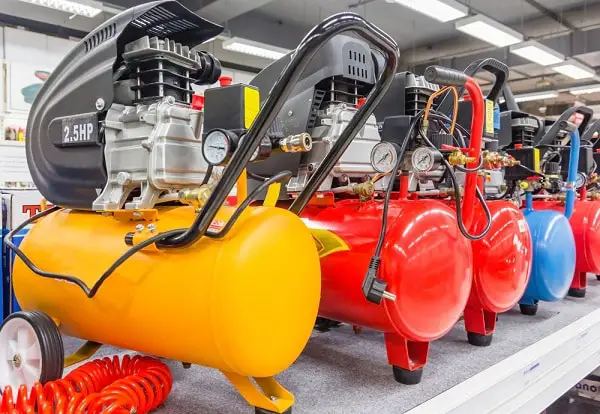
Staring down a line of air compressor at Home Depot, you stand there wondering what to buy. They all look alike. They has the same red and black finish.
They have almost the exact same motor housing. There is one exception. The digits on the side differ.
One has 6 gallons printed on it, while the other has 30. Which do you grab? You need them for hanging drywall or sanding a deck.
Understanding How to Size Air Compressor Tanks
Understanding Tank Volume vs Power
Well, this isn’t a power question. It’s a volume question. Most people thinks “more powerful” mean “higher PSI,” but that’s wrong.
What will make your tool run smoothly or stutter to a halt is how big the tank are. Because the tank acts as a reservoir that stores compressed air, you don’t have to wait for motor to build pressure after every spray or nail; So if your tank isn’t big enough then instead of spending actual work time spraying nails or glue, you’re wasting it hearing the compressor turn off and back on. What should of been a fluid operation becomes a stop-and-start one, which is why learning this math about those gallon will affect what you buy next time.
It’s no longer about loudest motor but rather the most practical capacity, and you’ll go from guessing to calculating.
Duty Cycle and Tool Requirements
The first thing to understand are the duty cycle. The Duty Cycle refers to how much time a tool operates divided by amount of time it’s not operating.
When you’re firing a finish nailer, the tool fires in a series of short bursts, with each shot separated by enough space to allow tank to replenish rapidy. That’s why a small tank is sufficient. However, when you’re sanding or grinding away on something with sander or die grinder, you has the trigger depressed for minutes at a time.
Those tools drinks a lot of air, and require a large reservoir to maintain consistant pressure. Match your tank to your tool; don’t match your tool to the tank.
Calculating CFM Needs
Second, determine the true CFM need.
CFM stands for cubic feet per minute and that’s how much air your tool use. Look at your tool’s spec sheet. Find where they rate it for CFM at what PSI?
It’s most likely printed right there. If yours requires 5 CFM at 90 PSI but your compressor produce only 3 CFM, oh boy, you have a problem. You’ll pull air out faster then you can replace it.
Your motor won’t keep up. Pressure will fall and the tool stall. Again, just a matter of outflow vs. Inflow.
The Battery Analogy for Tank Size
Supply and demand meet in tank size, More air volume = a larger tank. Imagine your tank as a battery. A small battery will power a light bulb for an hour while a large battery do it for a day.
When you’re not using your tank (light bulb), the compressor motor charge your tank; when you pull the trigger, you discharge your tank. As long as the charge rate is greater then the discharge rate, all is good. If not, you need a bigger battery (tank).
This is also why a 30-gallon tank feel like a smoother experience than a 6-gallon tank with the same motor, because it’s got more air volume.
Trade Offs Between Size and Portability
Tank size has a hidden cost of noise and space. Big tanks are bulky and heavy.
Taking up floor space in your shop and requiring more maintenance and oil. On the other hand, small tanks is quiet and portable, easy to move around a job site. If you need portability then maybe a small tank will do.
But if you’re a pro framing a house, you need big one. There’s no free lunch here, and you get to make the decision based off what’s important to you. Do you need performance or portability?
For a weekend warrior painting a room, a small tank may be all you need.
Recovery Time and Work Patterns
Compressor recovery time is how long it takes your compressor to fill the tank up from empty to full pressure. The bigger the tank the longer.
Smaller tanks fills up faster. So if you do intermittent work, then the faster rate of recovery are more important than the overall volume. You can work in short bursts and refill quickly.
But if you’re doing continuous work, then total volume become more important. Because now you want to be able to have enough air stored on board to make it through the job without waiting for tank to recover. Know your work pattern before you buy the hardware.
Choosing the Right Specs for Your Workflow
In summary, choose the compressor with the specs best suited to your workflow. Don’t buy too big unless you’re using air tools all the time; it’s a waste of space and money. Also don’t buy too small if you intend on doing some serious stuff; it’ll be frustrating.
Check out what CFM your tools requires and how fast your compressor recovers the air. Then check out the size of the tank. The numbers will speak to you.
Get the one that allows you to work freely without having to wait around. When you get into the zone with your work, so should the air.