A roofing nailer won’t fire. Nothing happen when you pull the trigger. The silence means there’s trouble on the job site, You’re stuck on a hot roof with a tool that doesn’t drive a fastener.
In most cases, it’s not the nailer causing the issue. Almost always, it’s the air supply failing to keep pace with demand. Roofing compressors can feel like a guess, but once you know how pressure works with volume, choosing the right one get easier.
How To Choose The Right Compressor Size
Understanding CFM vs Tank Size
The default for most homeowners is to purchase based off tank size. They think a larger tank equals more power. No!
That’s a common mistake. Tank size simply measures how long it takes until the compressor need to restart. It doesn’t measure whether it can drive a single nail or not.
What matters is cubic feet per minute, or CFM. Match the nailer’s appetite with the output of the compressor, and not capacity of the tank. Everything will be different when you understand the distinction between CFM and PSI.
CFM is cubic feet per minute. This number represent the volume of air flowing out of the tool. Typically, roofers need between 70 and 120 PSI for their roofing nailer to work properly.
That sounds easy enough, right? A lot of consumer compressor can get up to those pressure level without a problem. Where it becomes tricky is keeping that pressure as the tool fire away.
The second number is CFM, which stand for cubic feet per minute; meaning how much air is being pushed from the tool. Here’s where most folks run into trouble. Every time you drive a fastener with an air-powered roofing nailer, it eats up air in a hurry.
That means pressure at the tool drops. The tool stall. You pull the trigger and nothing happen or you get a soft drive.
Then you wait while the tank refills, slowing your progress down like molasses. Gas-powered nailers has their downsides, but they also work great. Excellent brands such as DeWalt and Milwaukee make some nice gas-only model, which means no need for an air line at all.
Gas vs Pneumatic Nailer Systems
These also weigh less and will let you move around the roof freely without having to drag your air hose around. The kicker is price per nail. You’re mixing in oil and paying for fuel cell.
On a residential roof, it may be worth it for the convenience. If you’re a contractor going out on multiple job weekly, though, the recurring fuel cost can add up fast. For pneumatics-only folks: You will want a compressor that can support airflow requirements.
While small, portable pancake compressor are attractive due to how easy they are to carry and their low cost, they also often lack enough motor power to keep up when it’s hot out or if you take them to higher altitude. Heat diminishes air density. Higher altitude mean lower air pressure.
What works well in a shop located near sea level might not work so well on house on a hillside. The point is that you’ll want some extra room on your CFM rating for these changes in the environment. Read your tool specs.
Matching Compressor Power to Needs
Check the nailer’s operating pressure from its manual and find what CFM rating is needed to operate properly. Your nailer might require 3 CFM at 90 PSI; don’t purchase a compressor with a 3 CFM output. You’re going to be pushing it.
Instead, get a compressor rated for at minimum 20% above your tool’s CFM rating. The extra cushion buffers the air pressure so the tool perform well even if you’re rapidly firing several nails in a row. It also protects against premature wear on your compressor’s motor and helps keep the tool responsive.
Surprisingly, the diameter and length of your hose matter too. As air pass down the hose, it loses pressure. The thinner and longer the hose is, the greater resistance will be.
The Impact of Air Hose Resistance
We call it pressure drop. Running a 50 foot long quarter inch hose will rob you of some serious CFM by the time it hits your tool. If you upgrade to three eighth-inch diameter hose you’ll reduce the resistance which lets the air flow more freely.
This small upgrade has a noticeably different impact on driving power. It also depend on what kind of roof you’re using. Soft roofs such as asphalt shingles don’t take very much driving power.
Heavier roofing type like slate and concrete tile need a lot more punch. It takes a lot more impact force to drive into thick slate. That means needing greater CFM.
When working on heavy clay tiles, I’m sorry but the average pancake compressor isn’t going to cut it for you. You’ll be wanting something bigger (stationary) or better (gas-powered). Then there’s the noise thing to think about.
A gas nailer is loud. A loud loud. Every time you pull that trigger it will go ‘bang’.
The pneumatic system is quieter but the compressor motor might not be. Perhaps the decibel rating is an issue if you’re in a residential area and noise ordinances are strictly enforced. An electric compressor tend to be quieter than a gas engine.
They create zero fumes either. That’s a nice feature if you’ll be doing some indoor attic work or in a confined space with poor ventilation. The last part of the puzzle is portability.
Finding the Right Balance

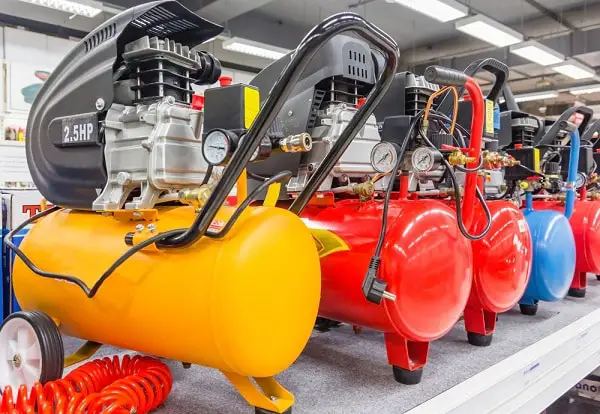
It’s both impractical and downright dangerous to lug around a heavy stationary compressor on a ladder. That’s why pancake and hot dog style compressor exist. They’re lightweight and portable.
But don’t forget: power and portability are two sides of the same coin. You can easily grab a tiny compressor and tote it around, but will it have the lungs to drive those nails? You want to find the sweet spot.
Pick the smallest compressor that has enough CFM for your needs and gives you some healthy wiggle room. Know how many CFM your nailer require. Get a bigger compressor than this rating.
Go ahead, get the higher CFM model even if it’s a bit pricey now. Spending a few extra bucks now is cheaper then wasting time trying to force tools to function because you cut corners on airflow. Always get an air supply that matches the CFM demand of your tool.
This way you’ll get through your project faster, with no nerves frayed. It makes the physical work a smooth process.