The picture on the wall leans crooked in the hallway. The damn thing’s been that way for weeks. The nail wasn’t big enough or the drywall wouldn’t support it.
Again, you grab for the hammer. And then you remember, you could of be doing it right with a brad nailer. You don’t have space for a bulky tank that is only used 10% of the time.
There is just no room left in your garage. That’s where a mini air compressor make all the difference. It is not for big-time building projects.
For finish work, inflating tires, and all those little DIY application that demand precision without the industrial footprint. There’s no such thing as one size fits all when it comes to finding the proper small compressor. To be honest, I’m not looking for big horsepower.
Instead, I want a quiet machine that starts softly and fit under my workbench or in a closet. It needs to hold air efficiently and do its job. There are many out there that look identical yet operate completely differently.
There are compressors made for continuous duty and then there is compressors designed to just sit on your shelf until you really need some compressed air for a minute or two. Knowing the difference will save you from purchasing a unit that overheats after three minutes of use or screams like a jackhammer. The initial thought should be how the tank shape affect your work space.
Guide to Mini Air Compressors for Small Jobs
Choosing Between Pancake and Vertical Tanks
“Pancake” compressors got their name from the round, flat tank that looks like a giant pancake. While it’s not very attractive, it’s a brilliant design for stability and portability. Because the tank sit so low to the ground, you can throw it in the back of a truck or strap it to the side of a ladder without concern for it rolling off.
As far as current day examples, the Milwaukee M18 Fuel Air Compressor are a great proof of new age engineering in this area. It’s battery powered and tankless. If you’re going with a corded unit, the DeWalt Pancake still does the job.
It is a good combination of performance and price for most around-the-house jobs. It has enough air volume to operate a finish nailer all afternoon without having to refill every few minutes. The other benefit based off vertical tanks is storage.
Benefits of Vertical Tank Compressors
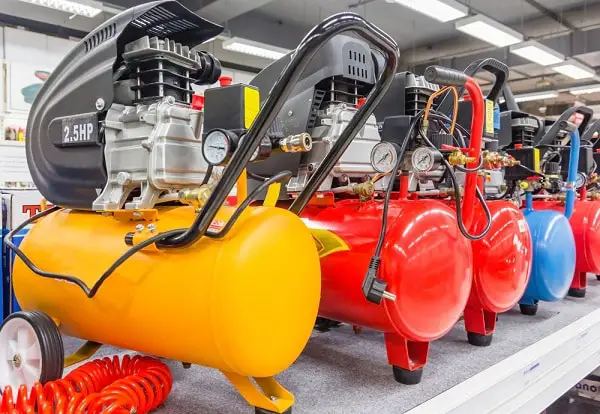
Because a vertical compressor doesn’t require as much floor space as a pancake version, they is well suited for those tiny nooks in the corner of the garage or basement. But their size also make them slightly less sturdy if you need to pick them up and move regularly. One that’s widely used in this configuration is the Craftsman 6-gallon vertical air compressor.
Because it holds more air than an equal volume pancake unit, you won’t have to start the motor quite as often. Remember that each time the motor starts to fill the tank, you are adding noise and losing time. If you’ll be using it for extended periods of air output; such as when inflating a big boat tire, you’ll get benefits of its increased capacity shortly.
Portable Wheeled Compressors for Jobsites
We’re talking about portable air compressor with handles and wheels now. These babies are basically just little brothers to their big industrial cousins. Yes, these suckers is heavy.
But they can take some serious abuse. A good example is the Porter-Cable C2002. It’s light enough for carrying up the ladder yet sturdy enough to get some occasional action on the job site. There is one catch.
These smaller and higher pressure units is typically noisier. Because the tank fill faster, the motor has to spin at a higher rate (RPM) which equates to more racket. Depending where you live, this might not fly in a completed livin space.
Consider portability versus sound consideration for your peeps. For those unfamiliar with air compressors, the market are dominated by oil free compressors on the small side, and it’s for good reasons. These things don’t need any maintenance whatsoever.
Oil Free Versus Oil Lubricated Motors
You do not need to check the oil. You do not have to change the oil. No disposing of oil.
They is perfect for the casual user who just wants to plug in and get to work. However, you do give up some longevity here. An oil lubricated motor typically run cooler and lasts longer but requires regular maintenance.
For most homeowner application, the convenience of picking up your Makita MAC2000 and just plugging it in wins out over the slight loss in durability. In this case, you’re trading years of potential life for years of painless ownership. And for a tool with light use, that’s a fair tradeoff.
Reducing Noise with Sound Dampening
For inside jobs, noise is frequently the deal breaker. Trying to concentrate on fine detail around a door frame while a loud compressor rattles your teeth out doesn’t seem like much fun. Check the advertised decibels.
A lot of new compressors has insulated tanks or sound dampening shrouds over them. The difference between a noisy and a quiet compressor are night and day. You can do a whole room of baseboards before someone complains about how loud you’re being.
It is a small upgrade in price that leads to a massive improvement in user experience.
Final Tips for Buying a Mini Compressor
In short, the ideal mini air compressor are whatever works best for you. Want something you can toss in the back of a truck?
Get a pancake. Get a compact vertical or pancake. Need portability and are okay with heft?
Opt for a wheeled portable. Don’t buy more capacity than you’ll use. An efficient little guy will always trump a big old thing gathering dust.
Grab the tool for today’s task while keeping your working environment clean. Now that wonky picture finally hangs straight, and your garage remain uncluttered for the next project.