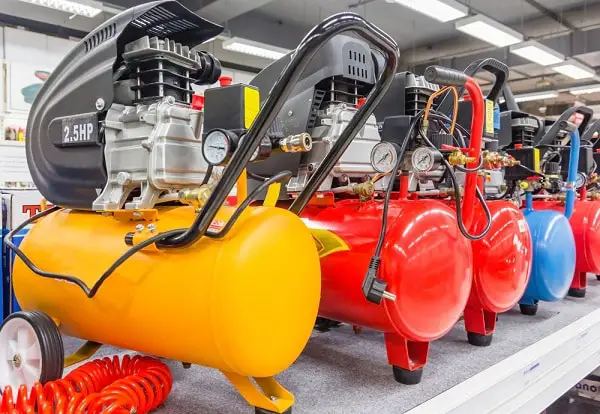
There are a straight hose and a coiled rope of rubber sitting in the aisle that you can’t decide between. One resembles a lazy river while the other resemble a slinky. It seems unimportant until you purchase it, then you’ll be wishing you purchased the other for the next six months.
You are choosing between how it looks, how it works and how easy it will be to use in your workshop. When most folks pick up that first hose to get at their job, they don’t think how they’re going to use it. They don’t factor in dragging a stiff tube across a concrete floor.
They don’t figure in the loss of pressure over fifty feet of tangled mess. How the hose is shaped affect how you work and how much air gets to your tool. And it affects whether you’ll ever be able to find end of the line when the compressor kicks on.
Comparing Coiled and Straight Air Hoses
The Battle: Straight vs. Coiled Hoses
Typically there are two primary players in the debate: One is the classic straight hose; the other is the memory spring coiled hose. Each has its own personality and addresses different issues. All that matters is where you live and how you hook up your tools.
Why Choose a Straight Hose
The workhorses of the trade are straight hoses (predictable), simple, durable and no frills. Unwrap ‘em, stretch ‘em out, then ignore ‘em. But beauty of a straight hose is that it has a consistant internal diameter from one end to the other, which allows for free flow of air with no restrictions, and that’s where you get max pressure at the nozzle.
When you’re running a sandblaster or an impact wrench, which are high-consumption tool, this is a big deal. The simplicity has a caveat. A straight hose doesn’t want to go anywhere.
It gets caught up in things like your boot, door frames and just about anything else that’s edged. It’s no big deal unless you have a set location for your compressor and workspace. Lay the hose down and leave it.
Advantages of Coiled Hoses
But if you’re walking a job site or a larger garage doing various job, you’ll find yourself spending more time untangling than actualy working. The mobility issue is solved by coiled hoses. And what do you know, they retract on their own when released.
Pull ‘em out, they follow you; release, and they snap back in a neat bundle. Why? Because there’s a memory spring wire wrapped around that inner tube.
It keeps those ends off the floor, no more getting them greasy or dirty with oil or sharp debris. That coil also compacts the hose so it doesn’t take up much room. It is handy for home garage, which has limited space.
Airflow and Pressure Trade-offs
There’s also some loss in airflow. That reinforcement of wire add thickness to the wall of the hose, reducing its internal diameter. Smaller bore equals more resistance to airflow.
Over distance, you lose pressure. So if you’re using something like a nail gun, which requires serious CFM, you may find that your nail gun isn’t drawing as much air from the tank. When pressurized, the hose will also tighten into a slight coil, further restricting airflow.
Small loss, but it’s measurable. For the light stuff I think your Ridgids and Campbell Hausfelds is fine. But on the heavy side get something industrial grade.
Durability and Maintenance Tips
The wire is not all created equal. And the cheap ones will kink and fail. They don’t retain their memory.
You’ll have one of those kinks where it will block airflow completely and won’t go away. You want a good coiled hose to remember and retract smoothly each time. If it’s fighting you, then it’s worn out already.
They’re also durable. Straight hoses get beat up. They get dragged around in the mud.
They get stepped on and run over by a car. This is because there is nothing inside them that can be damaged. A coiled hose is more delicate as the outside rubber can split along the bends where the coils turn, and even the wire can break in places.
So they requires care. And don’t leave them in direct sun all day every day for years, since UV degradation kills the rubber faster in a coiled hose than it does in a straight one. Also, remember that rubber gets stiffer in cold weather.
That makes for an even tougher-to-manage straight hose, and a coiled one that’s lost all spring. The latter may never go back into itself completely. Both kinds soften up in extreme heat; if you have left your coil compressed in a hot trunk, however, it will be more prone to permanent deformation.
Store your hose in a temp-controlled, shady spot to make the rubber last longer. The last consideration is storage. A straight hose fits nicely on a reel that’s mounted on a dedicated compressor cart.
Looks great and lasts forever. For those of us who don’t have a lot of wall space or have a jumble of tools in their garage, the coil is your friend. It takes up half the space, hides in a corner and goes away when not in use.
Choosing Based on Workflow
In a home shop, convenience usually wins out. If a tool is easy to use, you will be more likely to use it. Consider your work flow.
Does the compressor stay in one place while you move to where the tool is? In that case, a straight hose is best. It has a longer life and better pressure.
Do you walk from station to station getting air for various jobs? The coil will save you time. It eliminates trips and hazards while keeping work area clean.
Final Verdict
There is no right or wrong. Both have their rightful spot. The straight is the tried-and-true brute, the one who delivers in spades with no compromise.
The coiled is the neat assistant, the one who’s got your back for keeping things clean and organized about you. Decide what’s most important to you, and then go that way: Straight if power reigns; coiled if space are limited. What’s the best hose?
The answer: the hose you don’t hate to use. It is the one you’ll reach for year after year after year. If it frustrates you, it’s a barrier to your projects.
And you won’t use it, so there it sits in the corner. Why drag it out? The best hose is the one you don’t even notice.
It just works when you need it. Pull it out, get the job done and tuck it away. That’s how you keep the project moving forward.